
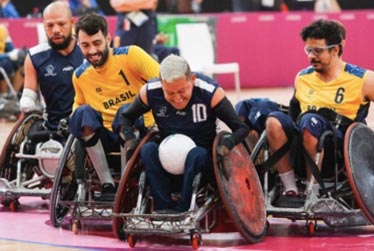
In 2026, Colombia was confirmed by the international federation as the host of the repechage tournament that will award quotas to the Wheelchair Rugby World Cup, which will be played in August in Brazil.
The event will be held in Medellín and will feature the participation of teams from New Zealand, Thailand, Korea, Holland, Switzerland, Argentina, Chile and Colombia.
This event represents a historic milestone as it will be the first time that the country hosts an international competition of this magnitude in this discipline.
The Innovation Table of the Global Compact Red Colombia is an ally to accompany the academic day of the Rugby World Cup to be held in Medellín.
Paralympic sport not only breaks records, it breaks prejudices. In Colombia, wheelchair rugby is consolidated as a high-performance discipline that promotes inclusion, equity and social development, aligned with the Sustainable Development Goals.
Sport as a driver of inclusion and human development
Sport has historically been a powerful tool for social transformation. Beyond competition, it represents a space for meeting, recognition and construction of citizenship. In the case of Paralympic sport, its impact is even more profound: not only does it encourage healthy habits and high performance, but it also challenges historical narratives of exclusion towards people with disabilities.
According to the United Nations (UN), more than 1,300 million people in the world live with some type of disability, which is equivalent to approximately 16% of the global population. However, this group faces greater barriers to accessing sports, education, employment and community life. In this context, adapted sport becomes a strategic tool to advance SDGs 3 (Good Health and Well-being), SDG 5 (Gender Equality), SDG 10 (Reduced Inequalities) and SDG 17 (Partnerships to achieve the Goals).
Structural challenges of Paralympic sport
Despite its social impact, Paralympic sport faces significant challenges at global and regional levels. The International Paralympic Committee (IPC) has pointed out that one of the main challenges is the funding gap compared to conventional sport, which limits access to infrastructure, specialised sports technology and high-level preparation processes.
Other key challenges include:
- Low media visibility, which reduces opportunities for sponsorship and social recognition.
- Limited access to adapted sports venues, especially in middle-income countries.
- Lack of specialized training for coaches, referees and technical staff.
- Persistence of social stigmas, which continue to associate disability with dependency and not with high performance.
According to the IPC, only a fraction of athletes with disabilities manage to access international competitions, despite the talent and discipline that characterize these athletes.
👉 https://www.paralympic.org/
Colombia and the development of Paralympic sport
In Colombia, Paralympic sport has experienced significant advances in the last decade. The Colombian Ministry of Sports has strengthened programs to support adapted sports, recognizing it as an axis of social inclusion and peacebuilding. According to official figures, the country has increased investment in Paralympic processes and has achieved outstanding participation in Parapan American and Paralympic Games.
However, challenges remain related to the financial sustainability of sports processes, the decentralization of the offer and the articulation with the private and academic sector.
👉 https://www.mindeporte.gov.co/
Wheelchair rugby: high performance, inclusion and social development in Colombia
What is wheelchair rugby?
Wheelchair rugby is a high-performance Paralympic sport played by people with physical disabilities that compromise all four limbs, such as spinal cord injuries, cerebral palsy, multiple amputations or neuromuscular diseases. It is played on an indoor court and pits two teams of four players against each other, combining regulated contact, strategy and high physical and mental demand.
Beyond competition, this discipline has established itself as a platform for inclusion, visibility of capabilities and promotion of values such as discipline, teamwork and resilience.
How is wheelchair rugby practiced and structured?
The objective of the game is to score points by crossing the goal line with the ball under control, using sports chairs designed for contact. The matches are played in four eight-minute halves and require strength, speed, coordination, tactical reading and decision-making under pressure.
To ensure competitive fairness, athletes are functionally classified according to their level of mobility. The sum of the functional scores of the four players on the court cannot exceed a limit established by the international federation.
In Colombia, the development of wheelchair rugby is structured through regional clubs, youth training processes, national championships and the progressive professionalization of coaches and athletes.
Case Spotlight | From abandonment to international high performance
The human dimension of wheelchair rugby is reflected in the life trajectories of its athletes. An outstanding player of the Colombian National Team lived a childhood marked by the absence of family and by a multiple amputation suffered at the age of seven, which included the loss of both legs and an arm. He grew up in adverse conditions and faced multiple difficulties during his personal formation process.
When he came of age, his life took a new direction when he was introduced to wheelchair rugby. What began as an opportunity for physical activity and community, became a life project. Thanks to discipline, perseverance and teamwork, he managed to join the Colombian National Team and represent the country in international competitions in North America and Europe.
Today, his performance has positioned him as one of the benchmarks of wheelchair rugby at an international level, reaching the first place in his position, demonstrating that high performance is built with character, preparation and vision of the future.
Evolution and international projection
Wheelchair rugby arrived in Colombia around 2007. Since then, a sustained sports process has been consolidated that has allowed the training of athletes and the participation of the Colombian National Team in international competitions with outstanding results.
In 2026, Colombia was confirmed by the international federation as the host of the repechage tournament that will award quotas to the Wheelchair Rugby World Cup, which will be played in August in Brazil. The event will be held in Medellín and will feature the participation of teams from New Zealand, Thailand, Korea, Holland, Switzerland, Argentina, Chile and Colombia.
This event represents a historic milestone as it will be the first time that the country hosts an international competition of this magnitude in this discipline.
Social, strategic and business value
Wheelchair rugby generates significant impacts in multiple dimensions:
- Social: promotes inclusion, the visibility of functional diversity and respect for the rights of people with disabilities.
- Academic: promotes research in adapted sports, rehabilitation and inclusion.
- Business: Offers shared value opportunities through sponsorships aligned with sustainability, equity, and human development.
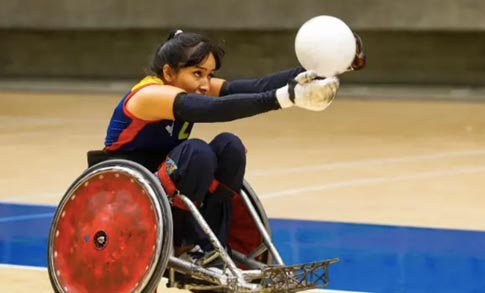
- Gender equity: from 2026 onwards, the formation of the first women’s wheelchair rugby team in Colombia will be promoted.
Conclusions | A call to support wheelchair rugby
Wheelchair rugby is not just a sport: it is a strategy for social transformation, a school of leadership and a concrete example of how the SDGs can be materialised in the territory.
Supporting this team means:
- Invest in real inclusion, not symbolic inclusion.
- Strengthen high-performance processes with social impact.
- Betting on narratives that recognize capacities and not limitations.
- Build alliances that leave a legacy.
On a court where everyone counts, wheelchair rugby proves that inclusion is also played at a high level.