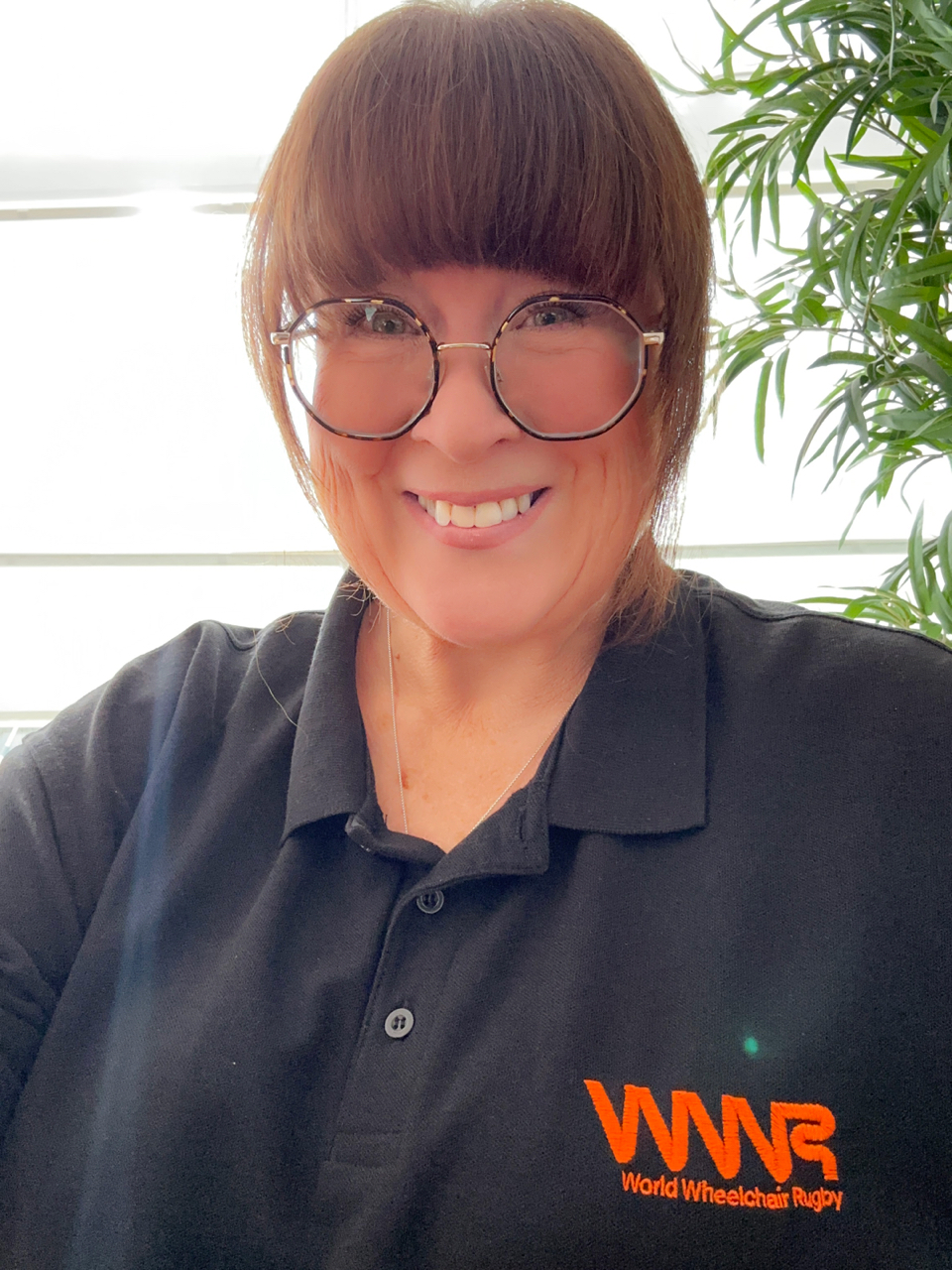
After a period of vacancy, WWR are pleased to announce that Dawn Watson, GBR has been appointed by the Board as the new Chair of the Competitions Working Group.
Dawn brings 17 years of wheelchair rugby experience to the role, from local club through to major international events. She has a deep commitment to advancing our strategic and operational goals and supporting the continued growth of the sport.
Dawn said “I’m honoured to accept the role of Chair of the Competitions Working Group and grateful for the support and confidence the Board has shown. I look forward to working with the WWR family over the coming months.”
The Competitions Working Group is responsible to advise the Board and WWR corporately on competition-related matters for the Paralympic sport of wheelchair rugby and its disciplines; amongst many duties it develops policies and procedures related to competitions, event authorisation, ranking, and qualification. The working group also lead on the evaluation of event bids, and make recommendations for event licensing, implement the qualification system for events; and to maintain the world ranking list and competition calendar.
WWR President, Richard Allcroft said “Competitions are our core business and the working group are responsible for many important areas and I know they are always busy. I’d like to thank Dawn for accepting this position and I know she will give everything and bring her experience to the sport globally.”
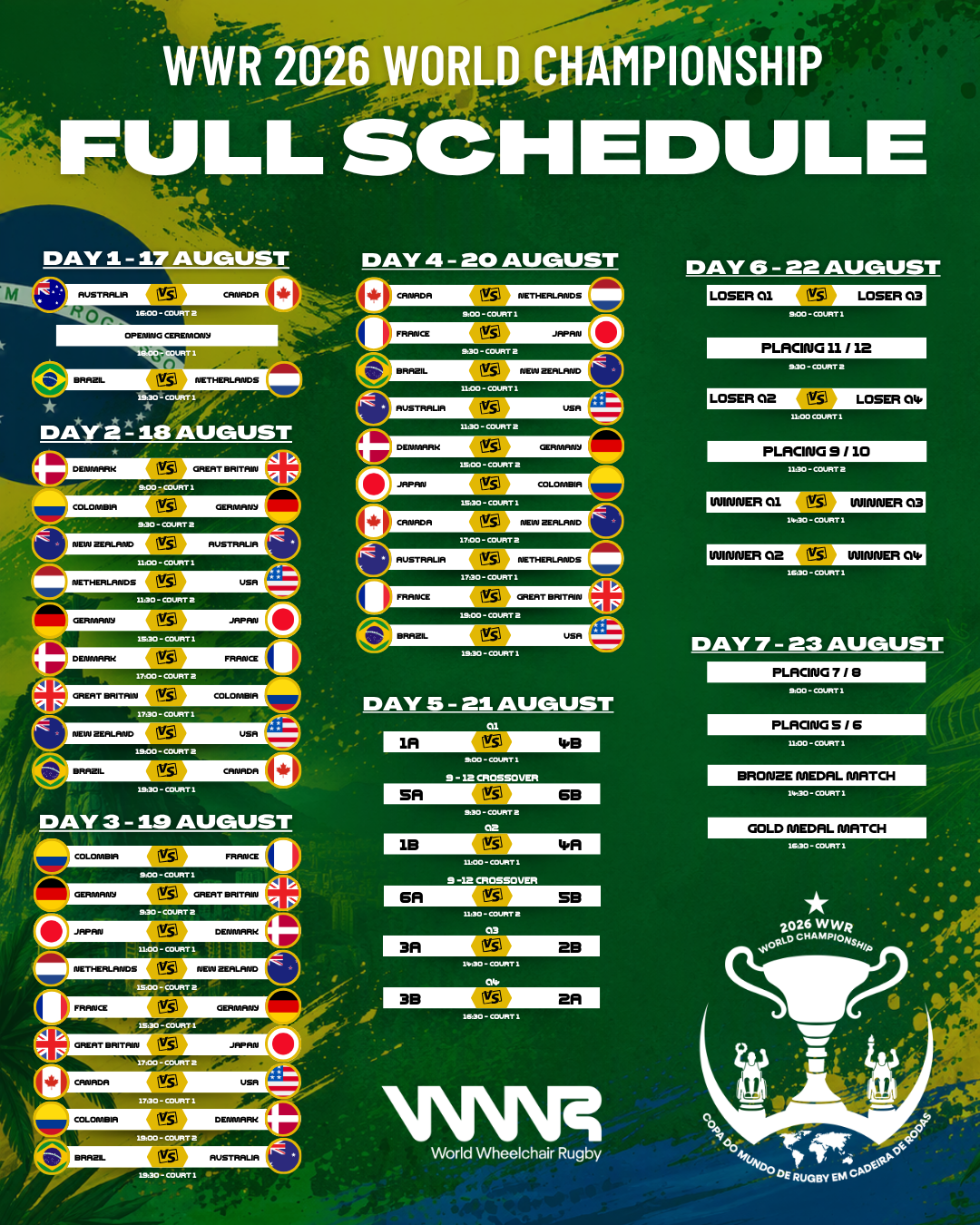
Dawn recently fulfilled the Technical Delegate role for the World Championship in São Paulo, Brazil. The event was successfully delivered with 8.4 million views across social media channels.
WWR is pleased to announce that Tokyo has been selected as the host city for the 2027 World Wheelchair Rugby Asia-Oceania Championship.
“It is exciting to see the Championship taking place in Japan and the opportunity to qualify to the next Paralympic Games in Los Angeles is one that I know the team will be strongly competing for. JWRF are a leader in the Asian region and I once again want to thank them for hosting this event and continuing legacy into their planning.” – Richard Allcroft OBE, WWR President
This Championship will serve as a crucial qualification tournament, with one qualification slot for the “LA28 Paralympic Games” allocated to the Asia-Oceania region. Building on the excitement of the “Mitsui Fudosan 2023 World Wheelchair Rugby Asia-Oceania Championship”, the event will once again be held at Yoyogi National Stadium First Gymnasium, the venue that hosted Wheelchair Rugby during the Tokyo 2020 Paralympic Games. As a legacy event, JWRF aims to provide fans with an even greater spectator experience through enhanced event planning while showcasing exciting wheelchair rugby competition.
Tournament Overview
Event Name 2027 World Wheelchair Rugby Asia-Oceania Championship
Dates 30 June – 4 July 2027 (tentative) *The schedule is subject to change depending on the number of participating teams.
Venue Yoyogi National Stadium First Gymnasium (2-1-1 Jinnan, Shibuya-ku, Tokyo 150-0041, Japan )
Participating Teams 4–6 teams (expected)
Host Japan Wheelchair Rugby Federation
*Further details regarding the event, including the participating teams, will be announced as event planning progresses.
We are delighted that Tokyo has been selected to host the “2027 World Wheelchair Rugby Asia-Oceania Championship”. – Tomohisa Yamano, JWRF President
This championship will be a crucial milestone on the road to the LA28 Paralympic Games, with only one qualification slot available for the Asia-Oceania region. Our historic gold medal at the Paris Paralympic Games was made possible by first securing qualification through the 2023 Asia-Oceania Championship. In 2027, we are determined to once again overcome strong rivals, including Australia, claim the regional title, and take the first step toward defending our Paralympic gold medal in Los Angeles.
JWRF would like to express our sincere gratitude to the Tokyo Metropolitan Government, Shibuya City, and everyone else who provided invaluable support throughout the bid process. We also extend our heartfelt thanks to our sponsors and fans for their continued encouragement. In recent years, Wheelchair Rugby has grown into a Paralympic sport that attracts the attention of many people in Japan, including through the TBS nationally broadcast television drama “GIFT”. We would like to take this opportunity to express our sincere appreciation to everyone who has contributed to the growth of our sport.
We invite everyone to experience the incredible speed and powerful collisions that are unique to wheelchair rugby by joining us at the venue. Together, we will create an outstanding championship.
It takes a massive amount of hard work and commitment to become certified as an International Wheelchair Rugby Referee, so it’s great to hear when new candidates achieve this milestone.
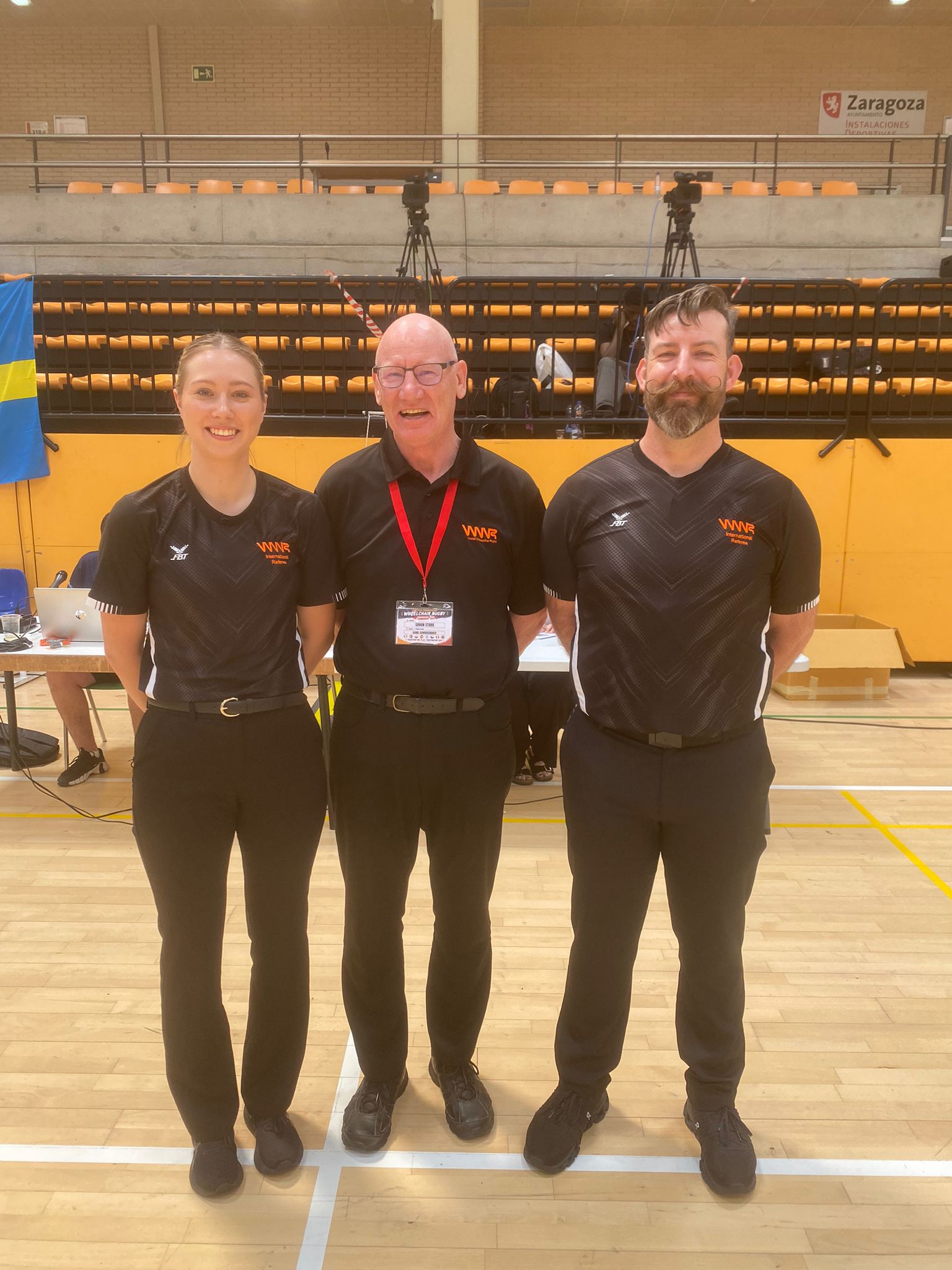
Well done Lucie Moravcovà, on becoming the first International Referee from the Czech Republic and to Marcus Ross, the latest GB Referee to achieve the high standard required. The path they had to tread was a challenging one. Firstly, they needed to be nominated by their home Governing Body as a candidate Referee. To even become a candidate, Referees need to have demonstrated over a significant period of time that they were capable of officiating at the highest levels.
On top of this, they had to pass both the fitness test and a rules test, set by WWR. The fitness test used is the Yo-Yo Test, similar to the Bleep Test that many of you will be familiar with, where you run shuttles over 20m and back at set speeds for a certain number of times, with the intervals getting shorter and shorter each time. You need to achieve Level 14.2, which is no mean feat and definitely not for the faint-hearted!
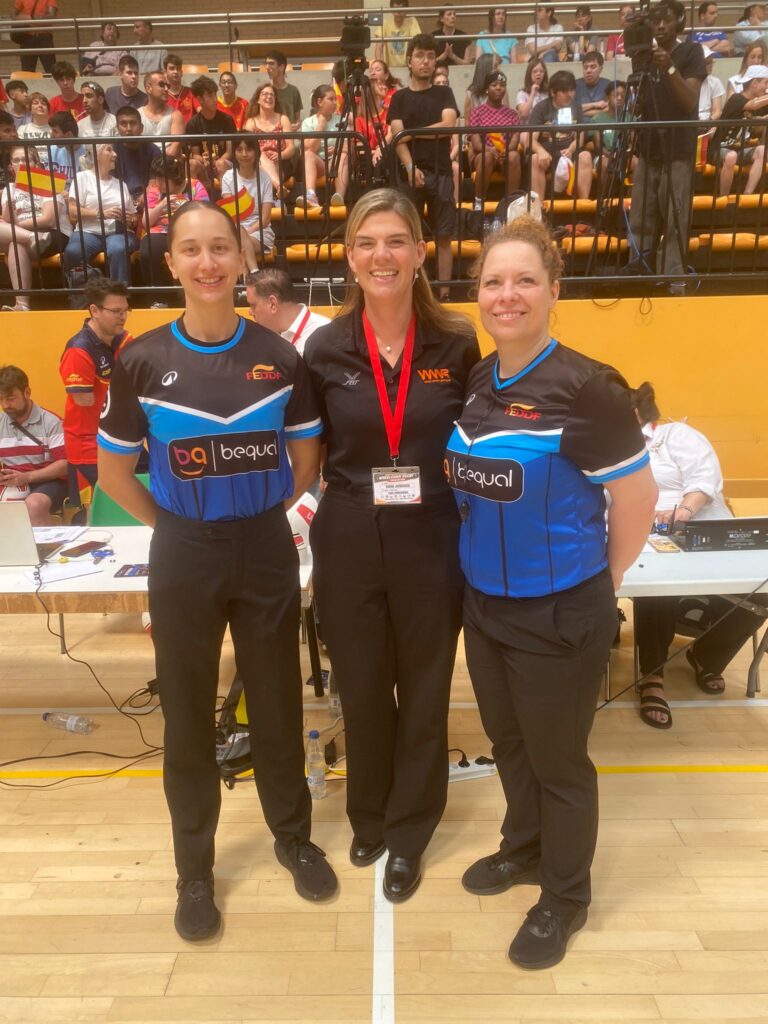
If that’s not enough, you must score 80% or more in the rules test, which tests your knowledge and interpretation of the International Rules and possible scenarios on and off the court. All of this happens before you even get invited to an International Tournament where you go through it all again. As well as having to pass the fitness test and the rules test, you also participate in the pre-tournament Chair Checks and then have your on-court performances assessed by a WWR Evaluator, all of which Lucie and Marcus did successfully, at the European B Championships held in Zaragoza, Spain at the end of May.
Their routes into Wheelchair Rugby were very different. Lucie came from a Basketball Refereeing background and after an approach from the Head Referee for Wheelchair Rugby to the Prague Basketball Referees Association, back in 2014, Lucie decided to ‘give it a go’ and the rest, as they say, is history. Conversely Marcus, a Military Physical Training Instructor, is used to coaching and refereeing many sports. His wife Vicky, was part of the GB Invictus Games team and he helped out at a Help 4 Heroes event in Plymouth, where his skills were recognised and the next thing he knew, he was on a Great Britain Wheelchair Rugby Fast-Track Refereeing Course led by Dave Woods, coincidentally the Head Official in Zaragoza.
Preparation for Zaragoza was pretty intense for both of them. Lucie, usually more of a cyclist and gym-goer, began running and practiced doing the old Bleep Test, then separately revised the International Rules and the WWR Referee Casebook. Similarly, Marcus started a Marathon Running Training programme, building up his endurance by daily sessions with the family dog running alongside, providing encouragement. As he pounded the pavements, his ear pods provided an audio soundtrack of the International Rules, a great example of multitasking! In addition, he refereed at a number of European events such as Bernd Best, Rugbymania and the Musholm Cup in Denmark. Wife Vicky also played regularly in the Polish Wheelchair Rugby Fives tournaments, so Marcus would referee in Poland and benefit from some excellent guidance and feedback from experienced international officials such as Lukasz Szymczak and Jarek Malec.
Both Lucie and Marcus were absolutely delighted to be told that they were now certified International Referees. “It’s hugely gratifying to be judged by your peers and I’m someone who really values feedback, both positive and negative”, stated Marcus. All of their hard work had paid off and Marcus is already looking ahead to applying for any International Tournaments that are circulated by WWR and any opportunities to expose himself to feedback in order to improve and grow as a Referee. Just recently, he has been part of a GB and Denmark Training Camp at Lilleshall, followed by a trip to Uganda to spread the gospel with a Welsh 5s Team. For Lucie, it’s a case of organising the Referees for Rugbymania, refereeing in the Czech and Polish Leagues and the thrill of a low point Tournament in Switzerland to look forward to.
There has been a wealth of very kind and heartfelt personal messages of congratulations for both Lucie and Marcus. “The news was received very positively within the Czech Wheelchair Rugby community. I received congratulations from the former Head Referee for the Czech Republic, players, fellow referees, and my boss. My achievement was also publicly acknowledged during a Czech League event. It was a reward for all the hard work and effort I’d put into the preparations, not only for me but also for the people who supported me and stood by me. In addition, I hope that Czech Wheelchair Rugby will become even more widely recognised in the rugby world” added Lucie. GBWR have recognised Marcus’s achievement on social media, which in turn prompted many more people, including all of his fellow GB Officials to say, ‘Well done!’.
Most memorable parts of the European B Championships for Marcus were being part of a Team of Officials drawn from across the globe and the great camaraderie between them all, the games where he made mistakes, which provided learning opportunities and his first game, which was in a great Stadium, with a great partner and making his first call, which was a really strong one, refusing a players’ Equipment request, which was merely an attempt to extricate himself from a tight situation. In a very similar vein for Lucie, it was all about being part of the Championships, working with other international referees and getting feedback after each game. It helped her to improve and made the whole experience even more valuable.
WWR is delighted to welcome Lucie and Marcus to the International fold and wishes them many years officiating at the highest levels.
World Wheelchair Rugby was sad to hear the recent news of the passing of David Hadfield OBE. David was the founding President of World Boccia and instrumental in creating the current International Federation.
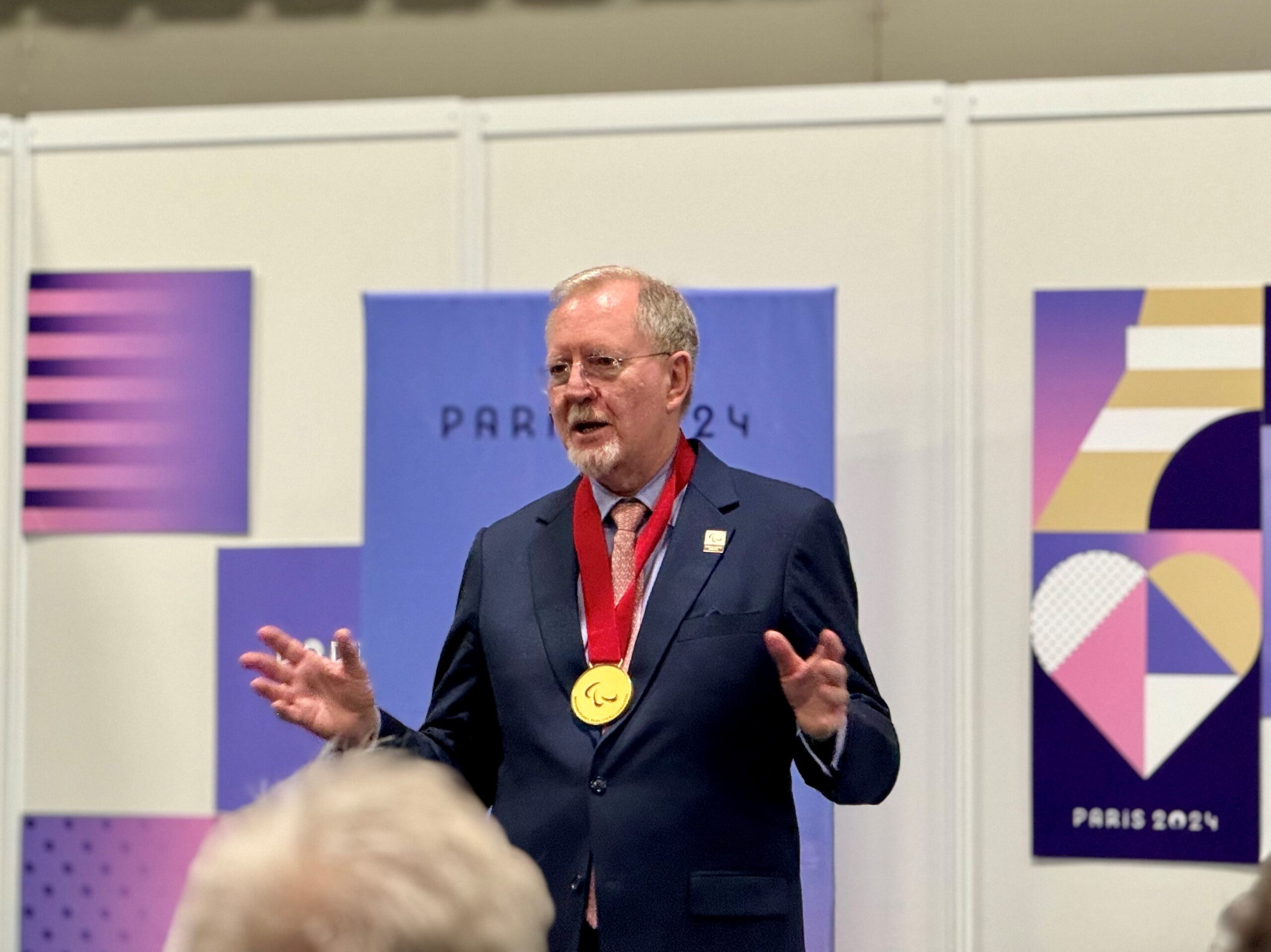
WWR President, Richard Allcroft said “it was upsetting news to hear about David’s death only a few days ago. I was fortunate enough to spend time with David on many occasions, often discussing our respective sports, as well as the Paralympic Movement. It was amazing to see what David achieved with Boccia and I asked him to share this as part of our strategic planning in 2019. Of course, he willingly accepted. Looking back, I am so glad to have spent time with him at Paris 2024 when I attended a small gathering to see him being presented with the Paralympic Order. Even more pleased, to have grabbed a drink with him and his wife Susan afterwards. My condolences to Susan and family and all at Boccia. He will be missed.”
World Wheelchair Rugby is pleased to announce the appointment of Dr Christopher White as its new Chief Medical Officer.
Dr White is Chair of the Department of Physical Medicine and Rehabilitation at the Medical College of Wisconsin. He completed his medical degree at the University of Oklahoma, followed by specialist training in Internal Medicine, Physical Medicine and Rehabilitation, and a fellowship in Spinal Cord Injury Medicine at the Medical College of Wisconsin.
He has worked across a range of clinical settings, including Baylor Scott and White in Dallas, Froedtert Hospital, and the Clement J. Zablocki VA Medical Center, with a career focused on spinal cord injury care, rehabilitation, and adaptive sport. He is also committed to educating future specialists in the field.
Dr White has extensive experience in adaptive sport at the local, national, and international level. He regularly provides medical coverage to his local adaptive sports partners including coverage for wheelchair basketball, American football, lacrosse, pickleball, and of course, his favourite adaptive sport, Wheelchair Rugby of which he is also a Level 1 Classifier. He has served on the medical team for the National Veterans Wheelchair Games and as a member of the National Classification team for the National Veterans Wheelchair Games as well. As a member of the USA Wheelchair Football Classification team, he was involved in establishing the classification scheme as the new sport was established. He remains actively involved in clinical research related to adaptive athletes including collision/impact studies for wheelchair rugby athletes and concussion testing for adaptive athletes
As CMO, Dr White will provide strategic medical guidance to WWR, supporting athlete welfare, anti-doping, and medical best practice across wheelchair rugby.
WWR looks forward to Dr White’s contribution to the continued development of the sport.
The WWR President is speaking at IWG’s Global Summit – will you join him?
Richard Allcroft OBE said “I’m proud to be part of the first wave of speakers announced for the IWG Global Summit 2026 – a defining global moment for women and girls in sport.”
Positioned as the Davos of Women’s Sport, the Summit will bring together a powerful international network of leaders, academics, practitioners and changemakers who are ready to move from conversation to action.
Join us as we share, connect and shape more and better opportunities for women and girls in and through sport.
The IWG Global Summit promises to be the world’s foremost gathering of leaders in sport, providing a platform for sharing best practices and the latest insights affecting women and girls in sport and physical activity.
Set against a moment of unprecedented opportunity, the Summit will serve as a catalyst for change – accelerating progress, challenging the status quo and uniting global voices around a common goal.
Our ambition is clear: to establish the Summit as the ‘Davos of Women’s Sport’ – the place where the world’s sport leaders, thinkers and changemakers come together to shape the future of gender equality in sport on a global scale.
Staged across three dynamic days, the Summit will provide an unparalleled opportunity to engage, learn and network with senior decision-makers and policymakers – and to be part of the solution in creating a sporting system where all women and girls can thrive.
Dr Lindsay Starling is Science and Medical Manager at World Rugby, where she connects research, policy and practice to advance player welfare. With a PhD focused on head injuries in rugby, she has led injury surveillance and research initiatives across international rugby organisations and continues to support evidence-based approaches to injury prevention.
Focus:
This presentation will provide a strategic overview of the evolution of concussion management in able-bodied rugby, highlighting the key milestones that have shaped current practice. It will explore how approaches have progressed across the system, including developments in injury surveillance, pitch-side assessment protocols, graduated return-to-play frameworks, education strategies, governance structures, and law adaptations.
A central focus will be on implementation, examining how research has translated into policy, and how policy has been embedded into practice across different levels of the game. The session will consider the factors that have enabled or challenged adoption, including stakeholder engagement, global dissemination, technology integration, and monitoring of effectiveness.
Finally, the presentation will reflect on how elements of this journey may be transferable to para-sport and wheelchair rugby contexts, while also aligning with World Rugby’s current strategic priorities and future directions for research and player welfare.
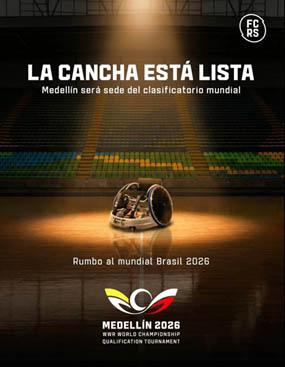
In 2026, Colombia was confirmed by the international federation as the host of the repechage tournament that will award quotas to the Wheelchair Rugby World Cup, which will be played in August in Brazil.
The event will be held in Medellín and will feature the participation of teams from New Zealand, Thailand, Korea, Holland, Switzerland, Argentina, Chile and Colombia.
This event represents a historic milestone as it will be the first time that the country hosts an international competition of this magnitude in this discipline.
The Innovation Table of the Global Compact Red Colombia is an ally to accompany the academic day of the Rugby World Cup to be held in Medellín.
Paralympic sport not only breaks records, it breaks prejudices. In Colombia, wheelchair rugby is consolidated as a high-performance discipline that promotes inclusion, equity and social development, aligned with the Sustainable Development Goals.
Sport as a driver of inclusion and human development
Sport has historically been a powerful tool for social transformation. Beyond competition, it represents a space for meeting, recognition and construction of citizenship. In the case of Paralympic sport, its impact is even more profound: not only does it encourage healthy habits and high performance, but it also challenges historical narratives of exclusion towards people with disabilities.
According to the United Nations (UN), more than 1,300 million people in the world live with some type of disability, which is equivalent to approximately 16% of the global population. However, this group faces greater barriers to accessing sports, education, employment and community life. In this context, adapted sport becomes a strategic tool to advance SDGs 3 (Good Health and Well-being), SDG 5 (Gender Equality), SDG 10 (Reduced Inequalities) and SDG 17 (Partnerships to achieve the Goals).
Structural challenges of Paralympic sport
Despite its social impact, Paralympic sport faces significant challenges at global and regional levels. The International Paralympic Committee (IPC) has pointed out that one of the main challenges is the funding gap compared to conventional sport, which limits access to infrastructure, specialised sports technology and high-level preparation processes.
Other key challenges include:
Low media visibility, which reduces opportunities for sponsorship and social recognition.
Limited access to adapted sports venues, especially in middle-income countries.
Lack of specialized training for coaches, referees and technical staff.
Persistence of social stigmas, which continue to associate disability with dependency and not with high performance.
According to the IPC, only a fraction of athletes with disabilities manage to access international competitions, despite the talent and discipline that characterize these athletes. 👉 https://www.paralympic.org/
Colombia and the development of Paralympic sport
In Colombia, Paralympic sport has experienced significant advances in the last decade. The Colombian Ministry of Sports has strengthened programs to support adapted sports, recognizing it as an axis of social inclusion and peacebuilding. According to official figures, the country has increased investment in Paralympic processes and has achieved outstanding participation in Parapan American and Paralympic Games.
However, challenges remain related to the financial sustainability of sports processes, the decentralization of the offer and the articulation with the private and academic sector.
Wheelchair rugby: high performance, inclusion and social development in Colombia
What is wheelchair rugby?
Wheelchair rugby is a high-performance Paralympic sport played by people with physical disabilities that compromise all four limbs, such as spinal cord injuries, cerebral palsy, multiple amputations or neuromuscular diseases. It is played on an indoor court and pits two teams of four players against each other, combining regulated contact, strategy and high physical and mental demand.
Beyond competition, this discipline has established itself as a platform for inclusion, visibility of capabilities and promotion of values such as discipline, teamwork and resilience.
How is wheelchair rugby practiced and structured?
The objective of the game is to score points by crossing the goal line with the ball under control, using sports chairs designed for contact. The matches are played in four eight-minute halves and require strength, speed, coordination, tactical reading and decision-making under pressure.
To ensure competitive fairness, athletes are functionally classified according to their level of mobility. The sum of the functional scores of the four players on the court cannot exceed a limit established by the international federation.
In Colombia, the development of wheelchair rugby is structured through regional clubs, youth training processes, national championships and the progressive professionalization of coaches and athletes.
Case Spotlight | From abandonment to international high performance
The human dimension of wheelchair rugby is reflected in the life trajectories of its athletes. An outstanding player of the Colombian National Team lived a childhood marked by the absence of family and by a multiple amputation suffered at the age of seven, which included the loss of both legs and an arm. He grew up in adverse conditions and faced multiple difficulties during his personal formation process.
When he came of age, his life took a new direction when he was introduced to wheelchair rugby. What began as an opportunity for physical activity and community, became a life project. Thanks to discipline, perseverance and teamwork, he managed to join the Colombian National Team and represent the country in international competitions in North America and Europe.
Today, his performance has positioned him as one of the benchmarks of wheelchair rugby at an international level, reaching the first place in his position, demonstrating that high performance is built with character, preparation and vision of the future.
Evolution and international projection
Wheelchair rugby arrived in Colombia around 2007. Since then, a sustained sports process has been consolidated that has allowed the training of athletes and the participation of the Colombian National Team in international competitions with outstanding results.
In 2026, Colombia was confirmed by the international federation as the host of the repechage tournament that will award quotas to the Wheelchair Rugby World Cup, which will be played in August in Brazil. The event will be held in Medellín and will feature the participation of teams from New Zealand, Thailand, Korea, Holland, Switzerland, Argentina, Chile and Colombia.
This event represents a historic milestone as it will be the first time that the country hosts an international competition of this magnitude in this discipline.
Social, strategic and business value
Wheelchair rugby generates significant impacts in multiple dimensions:
Social: promotes inclusion, the visibility of functional diversity and respect for the rights of people with disabilities.
Academic: promotes research in adapted sports, rehabilitation and inclusion.
Business: Offers shared value opportunities through sponsorships aligned with sustainability, equity, and human development.
Gender equity: from 2026 onwards, the formation of the first women’s wheelchair rugby team in Colombia will be promoted.
Conclusions | A call to support wheelchair rugby
Wheelchair rugby is not just a sport: it is a strategy for social transformation, a school of leadership and a concrete example of how the SDGs can be materialised in the territory.
Supporting this team means:
Invest in real inclusion, not symbolic inclusion.
Strengthen high-performance processes with social impact.
Betting on narratives that recognize capacities and not limitations.
Build alliances that leave a legacy.
On a court where everyone counts, wheelchair rugby proves that inclusion is also played at a high level.
Within the framework of the Qualifying Tournament for the 2026 Wheelchair Rugby World Championship – which will be held from April 12 to 19 (or 20) 2026 in Medellín, with the Iván de Bedout Coliseum as its main venue – the city becomes a living laboratory of social innovation where sport is no longer just competition and is consolidated as a real tool for social transformation. inclusion and sustainable development.
This high-level international event will not only bring together teams such as New Zealand, the Netherlands, Switzerland, Argentina, Chile and Colombia as the host country, but will also award three places to the 2026 Wheelchair Rugby World Championship, positioning Medellín as a key epicenter of adapted sport in the region.
Colombia’s participation in this scenario comes after securing its place in the playoffs thanks to its performance in the Copa América 2025, thus consolidating a sporting process that also reflects progress in inclusion and social development in the country.